Moving a heavy sleeper sofa can feel like an insurmountable challenge, often leading to fears of scratched floors, strained backs, or damaged doorways. This comprehensive guide will walk you through essential preparation, effective techniques, and the right tools to ensure your valuable furniture reaches its new spot without leaving a single mark on your cherished flooring. From measuring your space to mastering the lift, you’ll discover how to move your bulky sleeper sofa safely and efficiently, preserving both your home and your peace of mind.
Preparing for the Move: Essential Pre-Relocation Steps
|
Our Picks for the Best Sleeper Sofa in 2026
As an Amazon Associate I earn from qualifying purchases.
|
||
| Num | Product | Action |
|---|---|---|
| 1 | Oversized Boneless Loveseat, 3 Seater Pull Out Convertible Sofa Bed, 70" Gray Boneless Couch Fold Out Floor Couch Sleeper Sofa with 5 Pillows for Living Room Bedroom Lounge Small Space |

|
| 2 | Convertible Sofa Bed, Boneless Loveseat Folding Couch Bed Foldable - 3 in 1 Small Ccouch & Futon Sofa Sleeper, Corduroy Pull Out Couch with 4 Pillows for Living Room, Black |
|
| 3 | Convertible Sofa Bed Queen,5-in-1 Tri-Fold Boneless Couch with Removable Armrests & Handle,Corduroy Futon Sleeper Sofa,Floor Folding Mattress Pull Out Bed for Small Space Apartment Living Room Bedroom |
|
| 4 | MAXYOYO Folding Sofa Bed, Convertible Sleeper Chair with Pilow Foldable Matress with Back Support, Portable Fold Out Chair Bed Comfy Floor Sofa Lounge for Living Room Bedroom, Beige, Double |
|
| 5 | 5-in-1 Convertible Sofa Bed,60" Boneless Couch Tri Folding Floor Mattress with Removable L-Shaped Armrests & Handle,Corduroy Futon Couch Sleeper with Pull Out Bed for Living Room Bedroom Apartment |
|
| 6 | Folding Sofa Bed, Convertible Sleeper Chair with Back Support and Pillow Futon,Boneless Foldable Couch for Living Room/Guest Use/Home Office, Foldable Chair Bed for Adults, Dark Gray |
|
| 7 | Loveseat Boneless Convertible Sofa Bed, Folding Floor Futon Sleeper Sofa Couch Bed- Boneless Foldable Couch, Corduroy Pull Out Sofa Bed with 2 Pillows for Living Room & Bedroom |
|
| 8 | 79" Convertible Sleeper Sofa Bed with Cylindrical Pillow, Corduroy Folding Mattress Couch with Fixed-Shape Frame, Floor Sofa Lounge Couch for Living Room Bedroom Lounge Studio (Green) |
|
| 9 | COMAX Futon Sofa Bed, Convertible Folding Sofa Bed, Boneless Couch Loveseat Corduroy with Pillows, Small Foldable Floor Couch Comfy Lounge Sleeper for Living Room Bedroom, Green |
|
| 10 | MeMoreCool Boneless Folding Sofa Bed Queen – Corduroy Convertible Futon Couch, 2-in-1 Floor Sleeper with Foam Support, Detachable Pillow & Washable Cover for Living Room, Guest Room, Apartment |
|
Before you even attempt to lift your heavy sleeper sofa, thorough preparation is paramount to safeguard your floors and prevent injury. Begin by meticulously clearing the pathway from the sofa’s current location to its destination. Remove all obstacles such as rugs, decorative items, small furniture, and toys to ensure an unobstructed route, minimizing the risk of trips or accidental collisions that could damage walls or floors.
Next, accurately measure the dimensions of your sleeper sofa, paying close attention to its length, width, and height. Compare these measurements with all doorways, hallways, and staircases along your planned route. This crucial step helps you identify potential tight squeezes or areas where the sofa might not fit, allowing you to plan alternative strategies or prepare for partial disassembly.
To significantly lighten the load and make the sofa more manageable, disassemble any removable components. This includes cushions, pillows, and especially the pull-out mattress and its bed frame. Some sleeper sofas allow for the complete removal of the bed mechanism by loosening bolts found underneath the dust cover; if possible, this can drastically reduce the overall weight. If the bed frame cannot be removed, secure it tightly to the sofa’s main frame with heavy-duty rope or bungee cords to prevent it from accidentally opening during the move. For other components like legs or arms, unscrewing them can create extra clearance and prevent breakage.
Finally, gather all necessary tools and materials before you begin. Essential items include furniture sliders, moving blankets or thick towels, a furniture dolly (preferably with inflatable rubber wheels for hard surfaces), and lifting straps or a shoulder dolly system. Having these readily available will streamline the moving process and provide critical protection for your floors.
Protecting Your Floors: Safeguarding Against Damage
Protecting your floors is a non-negotiable step when moving a heavy sleeper sofa. The first line of defense begins with a thorough cleaning of your floors. Sweep or vacuum the entire moving path to eliminate any small debris, dirt, or grit that could get trapped under the sofa and act like sandpaper, causing deep scratches.
Choosing the right floor protection is crucial, as different flooring types require specific approaches. For hard surfaces such as hardwood, laminate, or tile, opt for felt-bottomed furniture sliders placed directly under the sofa’s legs or corners. Avoid using rubber-based materials on hardwood, as they can leave unsightly marks. Consider laying down heavy-duty floor protection like Ram Board, thick moving blankets, or even flattened cardboard boxes to create a temporary, protective walkway, especially for high-traffic areas or turns.
If you are moving across carpeted areas, plastic furniture sliders or protective carpet film can be invaluable. The plastic sliders glide smoothly over carpet fibers, while a tear-resistant film can prevent snags and punctures. Moving blankets are versatile and can be used on any floor type, either by wrapping the furniture itself to cushion impacts or by placing them directly on the floor as a protective layer. “The key is to create a barrier that reduces friction and shields your floors from the immense weight and potential sharp edges of the furniture,” advises a moving specialist.
Mastering the Lift: Safe Lifting and Moving Techniques
Executing the actual move requires proper technique to ensure both your safety and the integrity of your floors. The golden rule for lifting heavy objects is to always lift with your legs, not your back. Bend at your knees and hips, keeping your back straight and the sleeper sofa as close to your body as possible to maintain balance and reduce strain. Avoid twisting your torso while lifting or carrying; instead, pivot your feet to change direction.
For a heavy sleeper sofa, teamwork is essential. Always enlist at least one helper, and ideally more, to distribute the weight. Clear communication with your moving partners is vital; coordinate lifts and movements with a verbal count (e.g., “one, two, three, lift!”) to ensure everyone moves simultaneously. One effective strategy is the “high-low” method, where one person lifts the higher end of the sofa while another takes the lower end.
When navigating tight corners or doorways, the “pivot” technique can be a lifesaver. This involves carefully rotating the sofa on one corner while guiding the other end around the obstacle, ensuring that no part drags or scrapes against the floor or walls. Use furniture sliders to facilitate this maneuver, allowing the sofa to glide smoothly rather than being dragged. Remember, the goal is to lift or slide the sofa with protection, never to drag it directly across any surface.
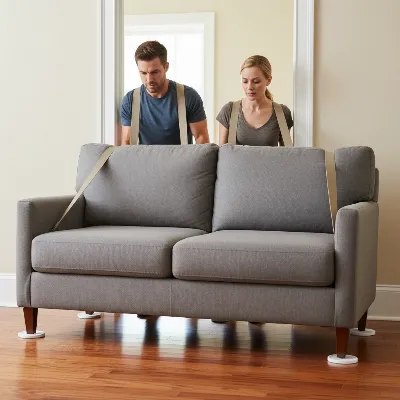 Two people using lifting straps to move a heavy sleeper sofa through a doorway, protecting the hardwood floor with sliders
Tools of the Trade: Equipment to Make Moving Easier
Investing in the right tools can transform the arduous task of moving a heavy sleeper sofa into a manageable one.
- Furniture Sliders: These are indispensable for moving heavy items across floors. Sliders come in various materials: felt-bottomed sliders are ideal for protecting hardwood, tile, and laminate floors, while plastic or hard-surface sliders are designed to glide effortlessly over carpeted areas. Place one under each leg or corner of the sofa.
- Furniture Dollies: A wheeled platform, a furniture dolly is excellent for moving heavy items across flat, level surfaces. For homes with hard floors, choose a dolly with soft rubber or inflatable rubber wheels to prevent scratches. If your dolly has hard wheels, lay down cardboard along the path to create a protective barrier. Secure the sleeper sofa to the dolly with straps to prevent shifting during transit.
- Lifting Straps or Shoulder Dollies: These ingenious tools redistribute the weight of the sleeper sofa from your back and arms to your stronger leg and shoulder muscles. Lifting straps consist of long, durable bands that wrap under the furniture and over your shoulders, creating a harness system that makes lifting feel significantly lighter and safer, especially for two people.
- Moving Blankets and Stretch Wrap: Beyond protecting your floors, these materials are crucial for safeguarding the sleeper sofa itself. Wrap the entire piece in thick moving blankets and secure them with stretch wrap or tape to prevent scuffs, tears, and dents as you navigate through doorways and hallways.
“Using specialized moving equipment isn’t just about making the job easier; it’s about making it safer for both your furniture and your body,” notes a seasoned moving professional.
Navigating Obstacles: Stairs, Doorways, and Tight Spaces
Moving a heavy sleeper sofa often involves navigating tricky architectural features. Careful planning and execution are key to conquering these obstacles.
- Stairs: Moving a sleeper sofa up or down stairs demands extra caution and at least two people. The person on the lower end should be the stronger one, holding the lowest point of the sofa, while the person at the higher end grasps the topmost edge. This keeps the sofa as upright as possible, preventing it from dragging. Utilize lifting straps to better distribute the weight. For particularly steep or winding staircases, sliding the sofa down on a durable moving blanket can be an effective method, with careful control from both ends. If using a dolly on stairs, ensure you have a spotter and tightly secure the furniture to the dolly.
- Doorways: Even after removing the sofa legs, you might find doorways to be a snug fit. Employ the pivot technique, angling the sofa through the opening. If a doorway is exceptionally narrow, temporarily removing the door from its hinges or even the door frame itself might be necessary for precious millimeters of clearance.
- Tight Spaces and Hallways: Before entering a tight hallway or making a sharp turn, clearly communicate with your partner. Plan your movements step-by-step. Use furniture sliders to help the sofa glide smoothly around corners without having to lift its full weight. Protecting walls with moving blankets or cardboard as you maneuver can also prevent scrapes.
Remember, patience and clear communication with your moving partners are your greatest assets when tackling challenging spaces. Rushing can lead to damage or injury.
Post-Move: Final Steps and Inspection
Once your heavy sleeper sofa is successfully in its new position, there are a few final steps to complete the process smoothly. First, carefully reassemble any parts you removed, such as legs, arms, and the mattress/bed frame mechanism. Double-check that all components are securely fastened before allowing anyone to use the sofa.
Next, take a moment to inspect your floors thoroughly for any unforeseen damage. Look for scratches, scuffs, or pressure marks that might have occurred despite your precautions. While the goal is to prevent all damage, a quick inspection allows you to identify any issues promptly.
Finally, clean up all protective materials, such as moving blankets, cardboard, and sliders. Store them properly for future use or dispose of them responsibly. Taking these post-move steps ensures that your sleeper sofa is ready for use and your home remains in pristine condition.
 A close-up of a person inspecting the hardwood floor for damage after moving a heavy sleeper sofa, highlighting the importance of post-move checks.
Conclusion
Moving a heavy sleeper sofa doesn’t have to be a daunting task filled with the dread of floor damage. By meticulously preparing your space, wisely choosing and utilizing protective tools, and employing safe lifting and maneuvering techniques, you can ensure a smooth, scratch-free transition for your furniture. Remember to always prioritize safety for both yourself and your home, embracing teamwork and patience throughout the process.
What other heavy furniture moving challenges have you successfully overcome in your home?
Frequently Asked Questions
What are the best furniture sliders for hardwood floors when moving a sleeper sofa?
For hardwood floors, felt-bottomed furniture sliders are highly recommended. These soft pads reduce friction and prevent scratches as you glide the heavy sleeper sofa across the surface. Ensure they are clean and free of debris for optimal protection.
How can I make a heavy sleeper sofa lighter before moving it?
To lighten a heavy sleeper sofa, first remove all cushions and pillows. Crucially, if possible, detach the pull-out mattress and its metal frame. Many sleeper sofas allow this by unscrewing bolts from underneath, significantly reducing the overall weight and bulk.
What is the safest way to lift a heavy sleeper sofa without back injury?
The safest way to lift a heavy sleeper sofa is to bend at your knees, not your waist, and use the strength of your leg muscles. Keep your back straight, maintain the sofa close to your body, and coordinate the lift with at least one other person to distribute the weight evenly.
Can I move a heavy sleeper sofa by myself, or do I need help?
Moving a heavy sleeper sofa by yourself is not recommended due to its significant weight and awkward size. It poses a high risk of personal injury and floor damage. Always enlist at least one helper, and ideally more, to ensure a safer and more efficient move.
What tools are essential for moving a sleeper sofa without scratching floors?
Essential tools include furniture sliders (felt for hard floors, plastic for carpet), thick moving blankets or pads, and a furniture dolly with soft rubber wheels. Lifting straps can also reduce strain and aid in precise movements, further minimizing floor risk.
How do I protect doorways and walls when moving a large sleeper sofa?
Protect doorways and walls by wrapping the sleeper sofa in moving blankets or padding, especially around corners and edges. You can also temporarily cover door frames and wall corners with cardboard or additional blankets to absorb impacts during navigation.
